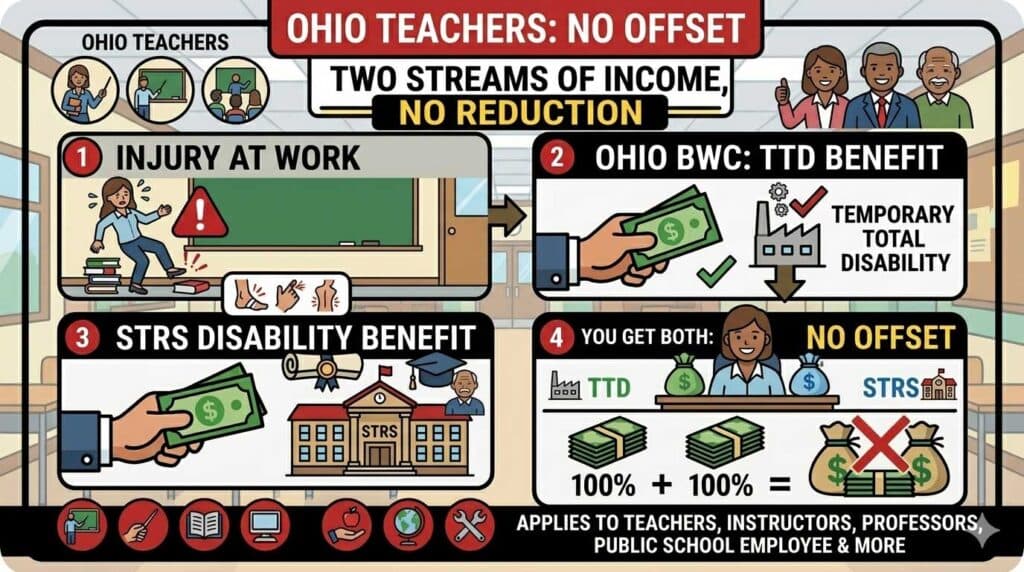
Ohio Teachers: There Is No Offset Between Workers’ Compensation Temporary Total Disability (TTD) and Your STRS Disability Benefit
If you are an Ohio teacher or public school employee who has been injured at work and wondering whether your Ohio Workers’ Compensation Temporary Total Disability (TTD) benefit will reduce your State Teachers Retirement System (STRS) disability benefit — or vice versa — the answer is clear: there is no offset between Ohio Workers’ Compensation TTD and STRS disability benefits. You are entitled to receive both at the same time, and neither payment reduces the other.
This question comes up often among injured teachers, and the confusion is understandable. Many assume that collecting money from two sources simultaneously must trigger some kind of reduction. Under Ohio law, it does not.
Who Is Covered by STRS Ohio?
The State Teachers Retirement System of Ohio (STRS) provides retirement, disability, and survivor benefits for Ohio’s public educators. STRS membership is mandatory for teachers and other licensed educators employed by Ohio public schools, community schools, and state-supported colleges and universities.
STRS covers a broad range of public education employees, including:
- Public school classroom teachers (K–12)
- School administrators and principals
- Guidance counselors and school psychologists
- College and university faculty at state-supported institutions
- Other licensed educational personnel in Ohio public schools
Note that non-teaching school support staff — such as custodians, bus drivers, cafeteria workers, and administrative assistants — are covered under the School Employees Retirement System (SERS), not STRS. And general public employees (county, municipal, and state workers) are covered under OPERS. Each system operates under its own body of law, but the same no-offset principle applies across all three when it comes to Ohio Workers’ Compensation TTD.
What Is Ohio Workers’ Compensation Temporary Total Disability (TTD)?
Temporary Total Disability (TTD) is a wage-replacement benefit paid through the Ohio Bureau of Workers’ Compensation (BWC) when a work-related injury or illness temporarily prevents you from returning to your job. Under Ohio Revised Code Section 4123.56, TTD is calculated as follows:
- First 12 weeks: 72% of your full weekly wage (FWW)
- After 12 weeks: 66⅔% of your average weekly wage (AWW) over the 52 weeks prior to injury
For 2025, the maximum TTD rate is $1,231 per week (without Social Security retirement benefits) and the minimum is $410.33 per week. These rates are adjusted annually by the Ohio BWC.
TTD continues until one of the following occurs:
- You return to work
- Your treating physician releases you to return to your former position
- Your employer offers a valid light-duty job within your medical restrictions
- You reach Maximum Medical Improvement (MMI) — the point at which your condition has stabilized and further functional improvement is not expected
What Is an STRS Ohio Disability Benefit?
STRS Ohio offers two disability benefit programs for members enrolled in the Defined Benefit Plan and the Combined Plan: a disability allowance and disability retirement. Members enrolled in the Defined Contribution Plan only are not eligible for STRS disability benefits.
Under Ohio Revised Code Section 3307.62, to qualify for STRS disability benefits you generally must:
- Service credit (members on account before June 30, 2013): At least 5 years of qualifying service credit, with application submitted within 2 years of your last date of earned service
- Service credit (members joining on or after July 1, 2013): At least 10 years of qualifying service credit, with application submitted within 1 year of your last date of contributing service
- Have a disabling condition that prevents you from performing your most recent job duties
- Have a disability expected to last at least 12 consecutive months
- Not be currently receiving STRS service retirement benefits
- Have the most service credit with STRS Ohio (versus OPERS or SERS, if applicable)
If approved, the STRS disability benefit is calculated as a percentage of the member’s final average salary (FAS), based on years of service credit multiplied by 2.2% — with a minimum benefit of 45% of FAS and a maximum of 60% of FAS. This is a meaningful monthly benefit, and it is entirely separate from — and not reduced by — any Ohio Workers’ Compensation TTD payments you may be receiving at the same time.
The Key Point: No Offset Between TTD and STRS Disability
Ohio Workers’ Compensation is governed by Ohio Revised Code Chapter 4123. STRS is governed by Ohio Revised Code Chapter 3307. These are entirely separate bodies of law, and neither statute imposes an offset of TTD benefits against STRS disability benefits.
In plain terms: if you are an Ohio teacher injured at work, you may collect your full TTD workers’ compensation benefit AND your full STRS disability benefit at the same time, without either one being reduced because of the other.
This is one of the most overlooked financial protections available to Ohio’s injured educators. Failing to pursue both benefits means leaving significant money on the table that you are legally entitled to receive — money that can make an enormous difference during a difficult recovery.
Important Distinctions to Keep in Mind
You cannot perform any teaching service while receiving STRS disability benefits. STRS Ohio broadly defines “teaching service” to include traditional and nontraditional teaching activities — full or part time, paid or volunteer, in or outside Ohio, in public or private settings. This includes writing curriculum, leading workshops, tutoring, and directing educational programs. Performing any such service can terminate your STRS disability benefit.
STRS and Social Security: STRS members who have also worked in the private sector may be affected by Social Security rules. However, as of January 5, 2025, the Social Security Fairness Act was signed into law, repealing the Windfall Elimination Provision (WEP) and the Government Pension Offset (GPO) — two provisions that previously reduced Social Security benefits for many Ohio public employees and educators. This is a significant recent development that may increase the total benefits available to some injured teachers.
PTD and Federal Benefits: Ohio Permanent Total Disability (PTD) workers’ compensation benefits — which are distinct from TTD — can be subject to offset if you are receiving federal disability benefits. This does not apply to TTD.
MMI and TTD Termination: A 2024 Ohio Supreme Court ruling (State ex rel. Dillon v. Indus. Comm., 2024-Ohio-744) gave employers and the BWC a faster mechanism to terminate TTD payments after a finding of Maximum Medical Improvement, and to seek reimbursement for overpayments. This makes experienced legal representation more important than ever during your TTD period.
UNUM and Supplemental Disability Plans: Some Ohio university and school district employees also carry supplemental long-term disability coverage through private carriers such as UNUM. Unlike STRS, these private plans often do offset benefits by amounts received from workers’ compensation and other sources. If you have supplemental disability coverage, review your policy carefully or consult an attorney to understand how it interacts with your TTD and STRS benefits.
Why This Matters — and What You Should Do
Ohio’s injured teachers are entitled to powerful financial protections — but only if they know to pursue them. The intersection of Ohio Workers’ Compensation, STRS disability benefits, and the newly expanded Social Security Fairness Act means that some injured educators may now have access to more combined income support than ever before.
Missing a deadline, failing to file the right form, or simply not knowing what you’re entitled to can cost you thousands of dollars. An experienced Ohio Workers’ Compensation attorney can help you pursue every benefit you’ve earned.
Mike Gruhin — OSBA Board Certified Specialist in Ohio Workers’ Compensation for over 30 years (1999–2030) — has represented thousands of Ohio’s injured public employees and educators, helping them obtain every dollar of benefits they are legally entitled to receive.
Read Mike’s free guide: The Officially Unofficial Injured Worker’s Guide to Ohio Workers’ Compensation — no cost, no obligation.
Ready to fight back? You don’t have to figure this out alone.
Contact Mike Gruhin for Your Free Consultation
The consultation is free, the information is free, and the conversation could change your life.
If you or someone you know has been injured at work and is struggling to move forward, you may have more legal options than you realize.
📞 216-861-5555
🌐 https://www.gruhin.com
📋 https://www.gruhin.com/contact
⚖️ Mike Gruhin — OSBA Board Certified Ohio Workers’ Compensation Specialist Attorney
(Certified 1999–2030).
Board Certification means exceptional competence, experience, and professionalism in workers’ comp law — recognized by the Ohio State Bar Association.
Mike Gruhin and Gruhin & Gruhin, LLC — Fighting for injured workers across Ohio.
DISCLAIMER: By accessing any website page or website post, the reader agrees that (1) The information above is general in nature and is not legal advice; (2) No attorney-client relationship is created; (3) Each claim is unique and must be carefully evaluated on its specific facts under current Ohio law and the most recent court decisions; and, (4) Such evaluations require advice from an experienced Ohio Workers’ Compensation Attorney.