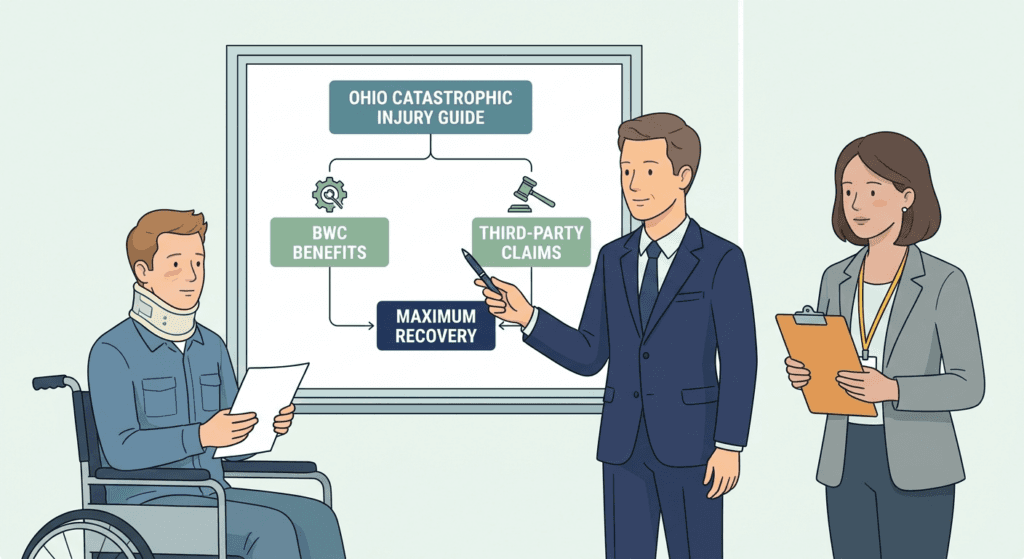
Catastrophic Injury in Ohio: Workers’ Comp & Serious Injury Rights
If you or someone you love has suffered a devastating injury in Ohio, you are likely overwhelmed. Whether it happened on a construction site, in a factory, or in a serious motor vehicle accident, the crisis is the same: the medical needs are real, the financial pressure is immediate, and the legal system is complex.
After 49+ years of practice representing injured Ohioans — including clients with spinal cord injuries, traumatic amputations, and fatal workplace accidents — here is the most critical fact you need to know: in catastrophic cases, there is almost always more than one legal path to recovery. Most injured workers and families never pursue all of them — and that gap can cost hundreds of thousands of dollars.
- If it happened at work: Your BWC claim is almost never your only claim.
- If it happened outside of work: You may have a personal injury claim involving motor vehicle negligence, a defective product, or both.
This guide explains both paths, what each one covers, and what deadlines you cannot afford to miss.
What Is a “Catastrophic Injury” Under Ohio Law?
Ohio law does not define “catastrophic injury” in a single statute, but the term has clear practical meaning in both workers’ compensation and personal injury practice. These are injuries that permanently change your ability to work, support your family, or live independently.
In Ohio BWC and serious personal injury cases, catastrophic injuries commonly include:
- Traumatic Brain Injury (TBI) — affecting cognitive function, memory, and motor control
- Spinal cord injury — resulting in partial or complete paralysis, including paraplegia or quadriplegia
- Amputation or loss of limb — including loss of fingers, hands, arms, feet, or legs
- Severe burns — causing permanent disfigurement or nerve damage
- Permanent loss of vision or hearing — total or near-total sensory loss
- Occupational cancer or toxic disease — conditions qualifying under R.C. 4123.68 or R.C. 4123.01(F)
- Fatal injuries — giving rise to BWC survivor benefits and/or wrongful death actions
If your injury is on this list, your case requires a different legal strategy — and almost certainly involves more than one avenue of recovery.
Two Paths to Recovery: Work-Related vs. Serious Personal Injury
The legal strategy changes depending on how the injury occurred. But the goal is always the same: maximize every dollar of recovery available under Ohio law.
Path 1: If the Injury Happened at Work
The Ohio workers’ compensation system is no-fault — meaning you do not have to prove your employer was negligent to receive benefits. That is a real advantage in the immediate aftermath of an injury. But no-fault comes with a trade-off: BWC benefits are capped, and certain damages are never available at all.
BWC covers your medical bills and replaces a portion of your lost wages through Temporary Total Disability (TTD). What it does not cover — ever — is pain and suffering, full lost earning capacity, or full family damages.
In many catastrophic workplace injury cases, a third-party claim exists alongside the BWC claim. A third-party claim arises when someone other than your employer caused or contributed to your injury. Under R.C. 4123.931, Ohio law requires coordination between the two — but that coordination is manageable with the right counsel. The two claims must be investigated simultaneously.
Common third parties in catastrophic workplace injury cases:
- Equipment or machinery manufacturers — defective presses, cranes, saws, or conveyor systems
- Property owners — when the injury occurred at a site owned by someone other than your employer
- General contractors or subcontractors — when a worker from a different company caused the incident
- Negligent commercial drivers — in work-related vehicle crashes
- Chemical or product manufacturers — in occupational disease cases involving asbestos, benzene, or other industrial exposures
Path 2: Serious Injuries Outside of Work
If your catastrophic injury resulted from a motor vehicle crash, a defective consumer product, or the negligence of another party unrelated to employment, you pursue a personal injury claim which, if not settled, must be filed in Ohio common pleas court prior to the expiration of the applicable statute of limitations. Unlike the BWC system, a personal injury claim allows you to recover:
- Pain and suffering — the physical and emotional toll of the injury
- Full lost earning capacity — the total value of your career, not a capped wage replacement percentage
- Loss of consortium — the impact the injury has on your spouse and children (R.C. 2125.02)
- Punitive damages — available when a defendant acted with conscious disregard for the safety of others
BWC vs. Serious Personal Injury: Side by Side
| What You Need | Ohio BWC Workers’ Comp | Serious Personal Injury / Wrongful Death |
|---|---|---|
| Medical treatment | Covered | Covered |
| Wage loss | TTD — capped by statewide AWW | Full lost earning capacity, past and future |
| Pain and suffering | Never available | Included |
| Permanent impairment | PPD or PTD award | Full diminished quality of life |
| Family damages | Limited BWC death benefits | Full loss of consortium (R.C. 2125.02) |
| Punitive damages | Never available | Available for gross negligence |
Permanent Total Disability (PTD): Ohio’s Highest Workers’ Comp Benefit
For the most severe workplace injuries, Ohio law provides Permanent Total Disability (PTD) — a lifetime benefit paid to workers who can never again perform sustained remunerative employment.
Under OAC 4121-3-34, PTD is evaluated using the Stephenson Factors, which consider your age, education, work history, transferable skills, vocational rehabilitation potential, and medical opinions regarding maximum medical improvement (MMI) and functional restrictions.
PTD is not granted automatically. The BWC and your employer will contest it aggressively, hiring their own medical examiners and vocational experts. Winning PTD requires carefully timed medical evidence, command of Industrial Commission procedure at the DHO and SHO levels, and counsel who has litigated these cases before. This is where Board Certification matters most.
Ohio Wrongful Death: Two Claims, Not One
When a catastrophic injury is fatal, surviving families face two distinct legal actions — with different courts, different rules, and different potential recoveries.
Ohio BWC Death Benefits (R.C. 4123.59): Weekly compensation to a surviving spouse and dependents, plus a burial expense allowance. Benefits continue until remarriage or until dependents reach majority.
Ohio Wrongful Death Claim (R.C. 2125.01–2125.04): Filed in common pleas court against the negligent third party. Recovers loss of support, services, companionship, and consortium. Punitive damages are available for gross negligence or conscious disregard for safety.
These are not duplicates. Families who pursue only the BWC death benefit — without investigating whether a third-party wrongful death claim exists — may leave the largest part of their recovery unclaimed.
Deadlines You Cannot Miss
1 year from the date of injury. Do not assume your employer filed the First Report of Injury (FROI) correctly — or at all.
1 year from the date of death.
1 year from the date of occurrence, OR 6 months from the date of diagnosis — whichever is later.
Generally 2 years from the date of injury. Product liability and governmental entity claims may have earlier notice requirements.
2 years from the date of death.
Frequently Asked Questions
Generally, no. Ohio’s workers’ compensation system is the exclusive remedy against your employer for work-related injuries. There is a narrow exception under R.C. 2745.01 for employer intentional torts — where the employer deliberately removed a safety guard or acted with specific intent to cause harm. These cases are difficult to prove but they do exist.
A denial is not the final word. You have the right to appeal before the Industrial Commission. The process has strict timelines — do not wait after receiving a denial letter from the BWC or the Ohio Industrial Commission.
In Ohio workers’ compensation cases, attorney fees are regulated and paid from your award — not out of pocket. In personal injury cases, representation is on a contingency basis. With Gruhin, you owe nothing unless you recover.
Not necessarily. In occupational disease cases especially, the discovery rule affects when the statute of limitations begins to run. Do not assume the deadline has passed without speaking to a qualified Ohio attorney.
Why Board Certification Matters
The Ohio State Bar Association (OSBA) certifies workers’ compensation attorneys as specialists in the field. Board Certification requires demonstrated experience, a rigorous written examination, and peer evaluation by judges and fellow practitioners.
I have held OSBA Board Certification in Ohio Workers’ Compensation since 1999. In over 49+ years of practice, I have represented Ohioans injured on and off the job. I have represented injured workers in PTD cases involving spinal cord injuries, traumatic amputations, severe burns, and fatal workplace accidents before the Industrial Commission. I have handled the coordination between active BWC claims and third-party product liability and wrongful death actions — the intersection where the most significant recoveries are won or lost. Whether navigating BWC subrogation under R.C. 4123.931, litigating PTD before the Industrial Commission, or coordinating a third-party product liability claim with or without an active BWC case, you receive the benefit of specialized experience — not a generalist learning on your case.
Talk to a Specialist Before the Deadline Passes
Mike Gruhin
OSBA Board Certified Ohio Workers’ Compensation Specialist (Certified 1999–2030)
Gruhin & Gruhin, Lawyers — By Appointment Only
24100 Chagrin Blvd, Suite 120 | Beachwood, Ohio 44122
Call: 216-861-5555
Online: gruhin.com/contact
Website: gruhin.com
No fees unless you recover.
This article is provided for general informational purposes and does not constitute legal advice. Ohio workers’ compensation and personal injury law is complex, fact-specific, and subject to change. Consult a qualified Ohio attorney regarding your individual circumstances.