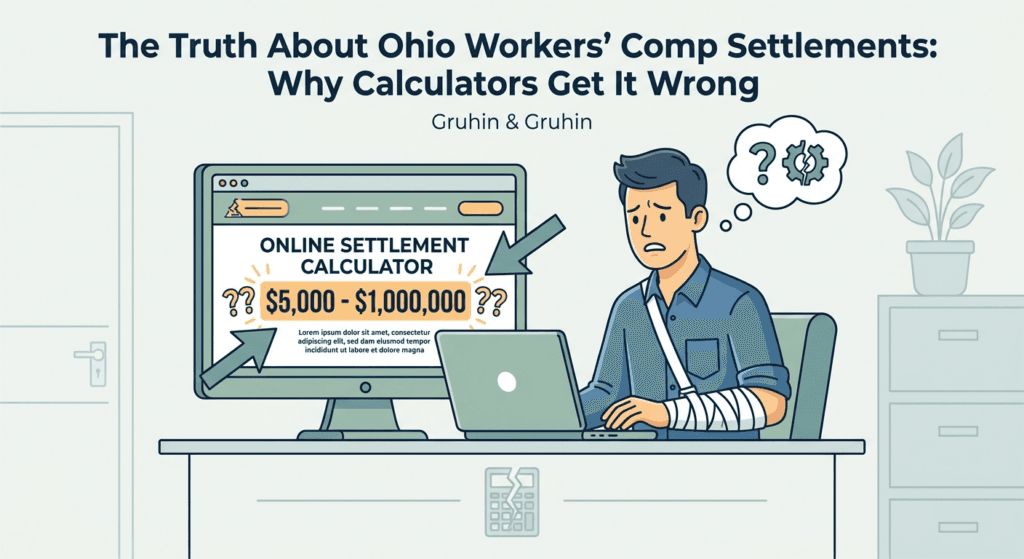
What Is My Ohio Workers’ Comp Claim Worth? A Board Certified Workers’ Compensation Specialist Answers the Questions Injured Workers Actually Ask
You didn’t expect this. You went to work like any other day — and now everything has changed. You’re in pain. You may not be able to work. The bills are arriving and the paychecks have stopped. Your employer’s third-party administrator or law firm has already assigned an adjuster or lawyer to your claim, and you can feel the pressure building.
So you do what everyone does: you search online for a “Workers’ Comp Settlement Calculator.”
What comes back are sliders and promises of instant answers. “Enter your injury and age, and see your check!” It feels reassuring — but it’s a trap. These tools are click-bait designed to harvest your data for submission to attorneys who pay for legal referral services or to lawyers looking to get new cases. That number on your screen, if one comes up at all, has no relationship to what your claim may actually be worth.
I know this because I’ve spent over 49 years handling Ohio workers’ compensation claims. I hold the OSBA Board Certification as a specialist lawyer in Ohio Workers’ Compensation — the highest credential the Ohio State Bar Association awards in this practice area. I have seen what these injury claims can become. I have seen a minor laceration turn into a catastrophic, life-altering injury worth more than anyone could have predicted on the day the claim was filed. No algorithm can predict the future of your biology.
What follows is a comprehensive analysis of how Ohio workers’ compensation claims are actually evaluated. There is strategy to that evaluation which no simple website calculator can give you. This is a long read — intentionally so. If you are casually curious, the section headers will give you the highlights. But if you are genuinely trying to understand what your claim is worth and why, every section has valuable information for you. This is the article the click-bait calculators don’t want you to find.
And I can tell you with absolute certainty: no website can tell you what your Ohio workers’ compensation claim is worth. Not because the websites won’t — but because the information needed to value your claim does not fully exist yet. The settlement value of your claim develops over time. It requires experience to see and expertise to pursue every benefit available. Any website telling you differently is hype, hoopla, and click-bait.
Q: Can a Website Calculator Value My Ohio Workers’ Comp Claim?
No — and here’s exactly why.
Online calculators share one fatal flaw: they assume the outcome is knowable at the start. In Ohio workers’ compensation, claim value is built over time through medical findings, functional assessments, employer decisions, Industrial Commission proceedings, and future estimations of payments yet to be made. A calculator has none of that information. And a calculator doesn’t ask if your claim is still in the administrative process or has proceeded to a Court of Common Pleas jury trial.
More importantly, unlike a personal injury claim which looks at past expenses, workers’ compensation valuation is about what flow-through conditions may be added to the claim and what monetary and medical benefits might reasonably be paid in the future. That is a forward-looking projection that requires legal experience to execute — reviewing medical records, meeting with the client to identify flow-through physical or psychological conditions, interpreting what can be claimed as additional allowances — all with an experienced eye toward adding claim value and driving the claim to its Peak Valuation Plateau. No algorithm can replicate it.
The numbers those calculators generate are reverse-engineered from settlement averages that bear no relationship to your specific injury, your specific employer, your specific medical history, or the hearing officer or Common Pleas jury who will decide your case. It is not a legitimate estimate. It’s an inaccurate guess dressed up in a fancy text box.
Know this: any algorithm or lawyer telling you what your claim is worth on the first day, first weeks, or first months after your injury date does not know what they are talking about. RUN from that situation before you find out the mistake you have made.
Q: What Actually Determines the Value of an Ohio Workers’ Comp Claim?
Value is built across multiple benefit categories, each with its own legal standard and its own forward-looking projection. Here is what drives each one.
Q: How Do “Flow-Through” Additional Claim Conditions Increase My Claim Value — and What Is TTD?
After the first 12 weeks, Temporary Total Disability (TTD) pays 66⅔% of your average weekly wage, subject to the statewide maximum and minimum in effect on your injury date. It continues until you return to work, reach Maximum Medical Improvement (MMI), or your physician certifies you can perform light duty your employer makes available.
But the valuation question is not based on what TTD has already been paid — it is based on how much more TTD can reasonably be predicted going forward. That forward projection is where experience matters.
Think of your claim like a beef stew. If all you have is beef and water, all you get is boiled meat. To build a rich, high-value stew, you need the potatoes, carrots, and onions. In legal terms, those are your flow-through conditions.
Under Ohio law, if a primary injury causes secondary flow-through problems, those additional conditions can be added to the BWC claim. A board-certified specialist can reasonably estimate future TTD exposure based on the injury type, treatment trajectory, work restrictions, and — critically — whether the allowed conditions are likely to expand. For example:
- A knee injury changes how you walk.
- That altered gait — like a car with a wheel out of alignment or tires out of balance — places abnormal stress on the opposite knee, the hips, and the lumbar spine. The vibration and uneven stress don’t stay in one place; they travel through the entire system, causing damage far from the original problem. The human body works exactly the same way.
- The chronic pain and disability may lead to an allowed Depressive Disorder or other psychological condition.
A board-certified specialist knows to look for exactly this. The contralateral knee condition, the hip degeneration, the back injury that developed because the claimant has been compensating for months — these are flow-through conditions that belong in the claim. Each one, once allowed, extends the treatment period, potentially extends TTD, and adds to the permanent impairment percentage at the PPD stage. I have had clients on TTD for 5 to 13 or more years based on additional conditions obtained through motions seeking such allowances.
A website calculator sees a “knee strain.” An experienced specialist sees the whole alignment problem — and knows how to add every condition that flows from it.
No website calculator knows your medical history, your treating physician’s approach, your employer’s response to light-duty requests, or whether your claim has untapped flow-through potential. That analysis is the experience factor — and it is exactly what separates a credentialed specialist from an algorithm.
Q: What Is Wage Loss Compensation — and How Does It Drive Settlement Value?
If you return to work earning less than your pre-injury wage, you are entitled to seek working wage loss — 66⅔% of the difference between your former and current earnings. If you cannot find work consistent with your medical restrictions, non-working wage loss may apply. Both are subject to the same statewide maximum as TTD and a specified maximum number of weeks.
What a certified specialist can do is project future wage loss exposure while the claimant is still on TTD. The length of the TTD period is itself a strong predictor of the severity of the functional limitations a claimant will carry back into the workforce. A claimant who has been on TTD for 6 months or more with multiple allowed conditions and documented permanent restrictions is almost certainly going to face a meaningful wage differential at MMI — whether returning to a working wage loss or being unable to return at the injury employer and seeking non-working wage loss. That future exposure can be estimated with reasonable confidence and factored into a justified settlement demand.
Ohio law provides a maximum number of weeks during which wage loss compensation can be paid. A specialist can look at the claimant’s current wage differential, apply it against the maximum weeks available, and produce a reasonable extrapolation of the total wage loss exposure remaining in the claim. That calculation — weekly differential multiplied by remaining eligible weeks — gives both the claimant and the attorney a concrete forward-looking number that becomes a critical component of overall claim valuation and settlement strategy.
A website calculator cannot tell you when — or whether — you should settle your claim. That decision depends on where you are in the benefit cycle, how much wage loss exposure remains, whether PTD is a realistic possibility, and a dozen other case-specific factors that require legal judgment, not arithmetic. Settling too early forfeits benefits you haven’t yet received and may never recover. If you haven’t reached your Peak Valuation Plateau, a calculator will lead you to settle for pennies on the dollar.
Q: What Is the Settlement Strategy for State Fund vs. Self-Insured Claims?
There is a critical strategic distinction at the settlement stage that depends entirely on who is administering your claim — and a specialist knows how to play each situation differently.
Self-Insured Employers: You hold significant leverage. The employer wants the liability off its books and can approach the claimant to initiate settlement discussions at any time. A specialist knows to read the signals of the employer’s exposure anxiety and negotiate from a position of strength. Initiating prematurely surrenders that leverage — the employer will sense urgency and offer lowball figures because they believe the injured worker is “hungry.”
State Fund (BWC) Claims: The dynamic is entirely different. Settlement is not initiated by waiting — it requires the claimant’s attorney to file a Form C-240 to formally open the settlement process with the BWC. Knowing when the claim is sufficiently developed — when the medical record is strong, when the wage loss picture is fully documented, when the PPD or PTD valuation is at its peak — is the strategic judgment call that determines whether a settlement reflects the true value of the claim or leaves money on the table.
These are not procedural details. They are strategic decisions that can mean the difference of tens of thousands of dollars in a claimant’s outcome. A website calculator has no concept of either.
I have personally handled thousands of both state fund and self-insured settlements over the course of my career. The strategic read on when to move, when to wait, and how to position a claim for maximum value at settlement is not something learned from a book or a course — it comes from having been at that table, in both settings, more times than I can count.
Q: What Is a Medicare Set-Aside — and Why It Can Be a Settlement Killer?
This is the most overlooked and consequential aspect of Ohio workers’ compensation settlement — and no website calculator addresses it at all.
If you are on Medicare or Medicaid at the time of settlement, or if you will become Medicare-eligible within 30 months of your settlement date — including anyone within 30 months of turning 65, when Medicare eligibility is automatic — federal law requires that a portion of your settlement be set aside to cover future medical expenses related to your claim before Medicare will pay for those expenses. This is called a Medicare Set-Aside (MSA).
The MSA comes directly out of your settlement proceeds. It is not an additional payment — it is a carve-out from the money you receive. This money is sequestered. It is not spendable cash for your mortgage or car. A claimant who believes they are settling for a significant sum may find that a substantial portion of those dollars are immediately locked in an MSA account that can only be spent on claim-related medical care.
A board-certified specialist identifies Medicare eligibility issues early, factors the projected MSA into the settlement valuation, and structures the settlement in a way that accounts for the MSA’s true impact on the claimant’s actual net spendable dollars. A claimant who settles without this analysis may walk away with far less usable money than they expected.
No website calculator asks whether you have a Medicare card. No calculator projects your MSA obligation. No calculator shows you what your settlement is actually worth after the federal government’s interest is protected. I do.
Q: How Does Permanent Partial Disability (PPD) Work — and What Will My Award Be?
Once you reach MMI — and after working or non-working wage loss is factored into the equation — your attorney should file for a permanent partial disability award under R.C. 4123.57. A physician examines you and assigns a whole-person impairment percentage under the AMA Guides. That percentage is multiplied by a statutory compensation rate to produce the award.
For specific body part losses — fingers, hands, arms, legs, vision, hearing — Ohio uses a scheduled loss table under R.C. 4123.57(B) that assigns a fixed number of weeks of compensation. Loss of two or more fingers by amputation or ankylosis, for example, may be increased beyond the standard finger award if the nature of the claimant’s employment makes the functional impairment exceed normal finger loss — up to but not exceeding the compensation for loss of the hand.
Forward-looking analysis drives PPD valuation as well. A claimant who currently has one allowed condition may — through flow-through recognition — have three or four allowed conditions by the time MMI is reached. Each additional allowed condition adds to the whole-person impairment percentage. A specialist can reasonably project the likely scope of the final PPD award, including conditions not yet formally recognized. A website calculator working only from the original allowed condition will dramatically undervalue a claim with significant flow-through potential.
Q: What Is Permanent Total Disability (PTD) — and How Is a PTD Claim Valued?
PTD is the most significant benefit in the Ohio workers’ compensation system. It compensates an injured worker who cannot perform sustained remunerative employment as a result of the allowed conditions — and it pays 66⅔% of the claimant’s average weekly wage for life, subject to the statewide maximum.
PTD adjudication is governed by the Stephenson factors: the claimant’s age, education, work history, physical condition, and ability to retrain or re-enter the workforce. The same physical impairment may produce a PTD award for a 58-year-old laborer with a 10th-grade education and no transferable skills — and a return-to-work order for a 35-year-old with a college degree and a sedentary work history. These are intensely fact-specific findings.
The valuation of a PTD award turns on two variables: the claimant’s average weekly wage and their life expectancy. AWW determines the weekly benefit amount. Life expectancy determines how many years — and how many hundreds of thousands or millions of dollars — that benefit stream is worth.
Q: How Do Life Expectancy Tables Affect PTD Value — and Can They Be Challenged?
This is where PTD valuation becomes adversarial — and where a certified specialist earns their fee.
The BWC applies its own reduced life expectancy table, which projects a shorter remaining lifespan than the standard U.S. Life Tables published by the Centers for Disease Control. The BWC will do everything in its power to minimize projected life expectancy. It will scour your private medical records for pre-existing conditions, lifestyle factors, and comorbidities — anything to argue you won’t live as long as the standard tables project.
A certified specialist fights back with evidence. That means obtaining the claimant’s private, non-BWC medical records for at least the prior two years — records the BWC does not have automatic access to — and building an affirmative case for life expectancy at or above the standard U.S. Life Tables. A claimant whose non-work-related medical history shows no significant conditions likely to shorten lifespan has a strong argument for the full U.S. Life Tables projection. That argument has to be developed, documented, and made. It does not happen automatically.
Consider the stakes: a claimant near the statewide maximum weekly rate, in their 40s, with 35 or more years of remaining life expectancy, has a PTD benefit stream worth well into seven figures at present value. The difference between the BWC life chart and the U.S. Life Tables is not a rounding error — it can represent years of additional compensation. If the BWC refuses to pay fair value, a specialist will tell you clearly that the claim should not be settled at the BWC’s offered figure.
Q: Can You Give a Real Example of a “Calculated” Value vs. an Actual Value?
Yes. And this is one I lived.
I was retained by a client who had suffered a cut on the dorsum — the top — of his right hand at work. On the surface it appeared to be a minor claim. A laceration. A straightforward allowance, some medical treatment, perhaps a small permanent partial disability award at the end. A website calculator would have valued that claim at a few thousand dollars.
That is not what happened.
Workers’ compensation claims take time to develop. Treatment, hearings, medical evaluations — the process moves slowly, and a great deal can happen while a claim is percolating. What happened in this case was that the client developed Reflex Sympathetic Dystrophy — now known as Complex Regional Pain Syndrome (CRPS) — a poorly understood and often devastating neurological condition that can be triggered by even minor tissue trauma.
CRPS does not stay where it starts. In this client’s case, the condition spread. His right hand contracted into a claw — rigid, non-functional, permanently disabled. Then it traveled. Up the right arm. Across to the left arm. Into the left hand. That hand became a claw as well.
This client ultimately received:
- Total loss of use of the right hand
- Total loss of use of the left hand
- Loss of use of both arms
- Statutory Permanent Total Disability for life
What a website called a “minor laceration” became one of the most catastrophic outcomes the Ohio workers’ compensation system recognizes — bilateral upper extremity loss of use and a lifetime PTD award. A claim worth hundreds of thousands of ongoing dollars.
No website calculator takes “laceration, dorsum right hand” and outputs that value. No algorithm accounts for CRPS, for bilateral spread, for the interaction between scheduled loss awards and statutory PTD. The only thing that catches a claim like this — that recognizes what it might become and protects the client’s rights at every stage — is an experienced specialist who has seen it before.
I had. And my client’s outcome reflected that.
This is why claim valuation at filing is not just difficult. In cases like this one, it is effectively impossible without the kind of experience that only comes from decades in this system.
Q: What Questions Should I Ask When Hiring an Ohio Workers’ Comp Attorney?
Not every attorney who handles workers’ comp claims has the same depth of experience. Before you sign anything or trust a slider on a website, ask:
- Are you OSBA Board Certified in Workers’ Compensation? Ohio is one of the few states that certifies workers’ compensation specialists through its bar association. Certification requires demonstrated experience, peer review, and a rigorous written examination.
- How long have you been handling Ohio workers’ comp cases? There is no substitute for decades of experience before the Ohio BWC and the Ohio Industrial Commission.
- Do you handle both IC hearings and court appeals? A full-service practice can pursue your claim at every level.
- What is your fee arrangement? Ohio workers’ comp attorneys are paid on a contingency fee basis. With Gruhin, you pay nothing up front and nothing unless you recover benefits.
Q: How Much Does It Cost to Consult with an Ohio Workers’ Comp Specialist?
Nothing. There is no upfront cost and no fee unless you recover benefits. If you have been injured at work in Ohio, you have nothing to lose by calling.
The Bottom Line
Your workers’ comp claim is worth exactly what the medical evidence, the legal record, and the Industrial Commission findings say it is — developed over time, through a process that requires expertise to navigate. No calculator can tell you that. No website can tell you that.
But an OSBA Board Certified specialist with 49+ years of experience in this system can evaluate your specific situation, project the full forward value of your claim, identify every flow-through condition that belongs in it, time the settlement for maximum value, and make sure the BWC does not shortchange you on any component — including life expectancy and your Medicare obligations.